Ugmonk's $1m Analog Landing Page
Read the transcript
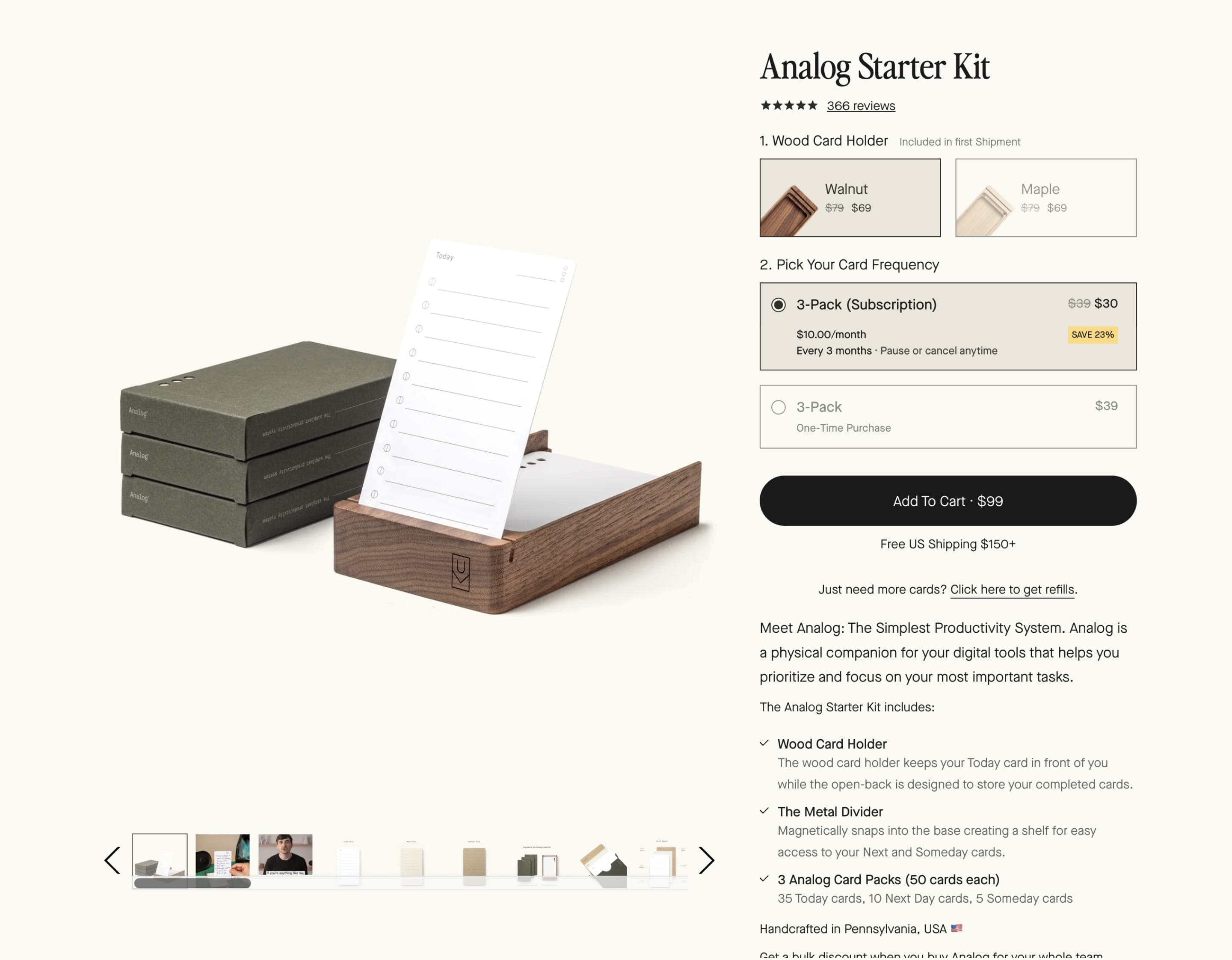
So I I like to really bring in the design aspect of copywriting where I wanna see it on the page. I wanna see where that line break is gonna hit. I wanna see how it looks on mobile. And those things have all played into, like, the copywriting side of it where it's not just the literal words. It's the words plus how they look and how they sound and how they feel on the actual page. Today, we're gonna talk about analog, which I'm not just being, like, I don't know about Them product. I know quite a bit about this analog product.
Nice. Today, we're just gonna wrap about just a few components behind the page. Really interesting to see how it's evolved over the years. But I just wanna clarify a few things just as, like, context for the listeners out there is that, you know, you've got a physical product, you know, you can get a One off purchase. It has to get shipped to Them, you Show, so this is a landing page that, you know, you need to convince them that it's quality build and there's you Show, we'll get into all that kind of stuff just now, but there's also subscription.
So there's sort of 2 different, objectives of the page. You can buy once off and you can also just get these cards that obviously run out One you can get them topped up, in intervals. So there's kind of 2 objectives One then you've got upsells, you know, with all the rest of the beautiful gear you have there. In the analogue landing pages, there's actually quite a few for, you know, your subproducts and so on. You've mentioned
40,000, 45,000 customers. Is that all UGGMUNK's customers, or is that just analogue? I actually haven't run the numbers recently. I think it's around 40,035,
40,000 on the analog card system. Wow. Show that would include, like, the Kickstarter from the Kickstarter until now. And, yeah, customers, I think, were were well into the 6 figures at this point.
Incredible. So, you know, just based on that, the minimum you can sort of pay right now off the landing page is, you know, roughly a $100. And I'm pretty sure on average, it's gotta be a $100 because people are, you know, getting Them add ons. So, you know, Kickstarter was 5,000 people. Just ballpark 30,000 people have grabbed the product. This is 1000000 dollar landing page. Is that safe to say? Yeah. I mean, we've pushed millions of dollars of sales through this page, which is kinda wild.
Looking back to when I created it, and we'll get into this when they start talking about the page, but I don't think I thought about it that way when I was making it. It was just Love, how do I tell the story of the product? But now it's become, yeah, pretty much, you know, the number 1 page on our site. Wow. Amazing. And, you know, you've linked to it on the Hope page, you know, navigation item number 1. And I guess that's worth talking about. You know, a lot of the stuff I encourage with landing pages is, you know, it's to do with, an entrepreneur that's just selling sort of 1 thing, so there's often not a navigation. But, you know, you've thought about this a lot. You know, you've spent so much time on your Shopify site. But your
biggest selling item, would you recommend it to other, you know, product makers out there? Just put it as navigation number 1. Yeah. I mean, again, I think we make things a little too complicated sometimes. And, like, if people are coming to the site because they heard of a certain thing, the last thing I wanna do is dig through collection pages to find, like, that 1 T shirt that everyone is looking for. So just the less clicks, the better. We have a lot of other products that you can get distracted with
looking at and browsing and finding, which is great for discoverability, but I try to just make it, like, right there. Just click right to the product, and get what you're looking for and what your friend told you about. So when it comes to Them copywriting, you know, you you have spent, you know, every waking, you know, day for the last 5 years on this product, let alone the years before. And I'm pretty sure that tagline and that subtext and stuff has been refined and probably, like, gone in circles back to, like, where you originally thought and so on. I just wanna know, like, right now, we've landed. You know, when you when you actually search for analog, okay, we've got a little bit of, like, that meta description of the page. It says, the power of a simple habit. Analog is a simple, repeatable process. Starting fresh with a new today card helps you adjust to your changing priorities. Like, it's a lovely overview in in the from a Google's point of view. But when you arrive on the page, it says,
straightforward, clean, no fuss. It just goes headline, the easiest way to get things done. Subtext goes, analog is a physical tool that helps you focus on your most important work. How much time have you spent on those 2 lines, Jeff? Probably too too much time. So if anybody anyone that knows me well knows that I tend to overthink things.
Maybe it's just the designer curse where we all, you know, we fuss with things so much that we if we just need to leave well enough alone. So that 1 has changed, I don't know, countless times that we've we've done had different headlines. But the interesting thing is and this might not be Them. There's gonna be a lot of designers listening. They're gonna be Love, wait. What?
As I haven't actually AB tested that thing, like, hardcore trying to get exact, you know, conversion rate. It's more of, like, a feel and a communication and a story and, like, learning from customers, refining that, trying it with the word productivity, trying it without the word productivity, trying it just to communicate clear. I think there's probably a lot of AB testing we could do on this on this page. But the page that headline has evolved with just as we've gotten to know how people are using the product and what resonates with them more than an actual, like, AB test, which 1 converts better. Yeah. It's an unpopular opinion, again, on my side too, but I think AB testing's overrated. You know, the
the way you talk about how you are only creating products and selling products that you'd use, you are, like, the ideal target market. And if you if there's 1 word out that doesn't feel right to you, it's probably not gonna go in. You know? So, like, you are the target market. So did you get any help with Them copy, or was it, like, Hope here's, like, sort Love where a baseline is, and do you, like, copy and paste to, like, 12 different friends One WhatsApp and go a o b, a o b, a o b? Yeah. More of the latter. And, you know, sometimes so what I think is really interesting about Hope, and I think copywriting is is I'm I'm not a copywriter by trade, and I think I have a lot a a large,
amount to grow in that area. Is that copy the way that it looks and the way that it sounds One the actual words all play into it. So writing this copy in a Google Doc and just writing different phrases might sound and look a certain way. But when you mock it up on a page in Them specific font, in Them specific size, next to the specific image, the copy has a different, harmony in the way that it's working with the other things on the page. So, like, sometimes it just looks raw. Right? Like, we look at words One we say, like, those letters, the the sound that they make, the way that the letters look on the page just don't roll off the tongue the way they did on the Google Doc that made so much sense.
So I I like to really bring in the design aspect of copywriting where I wanna see it on the page. I wanna see where that line break is gonna hit. I wanna see how it looks on mobile. And those things have all played into, like, the copywriting side of it where it's not just the literal words. It's the words plus how they look and how they sound and how they feel on the actual page. Classic on-site. Harry Drive from marketing, example. Oh, such a great video. Yeah. I just watched everybody should go watch that video. That's a master class right there. 76 minutes of pure gold with Love Peril. But he talks about how he mocks up his newsletter in the email program. You Show? He he, you know, does the website in the website builder just to give that extra feel exactly like you're talking about right now. So you've got a massive back end on what you're saying there. So just let's just go quick just to step into mobile.
Do you have, like, a rough ballpark of of, like, what percentage of sales you're getting on mobile? For this product specifically, it's probably a little bit higher. So this is the main product that we are pushing paid media to, and and specifically because this is, like, this is our hero product. So there's a lot more mobile traffic coming because people are clicking through from Instagram,
through Facebook, through Love. And then most likely, that's, you know, happening more on a mobile device. But our it's it's interesting because the last time I looked at our analytics, our desktop traffic is still relatively high. Like, it might be closer to 50 50, but we've always had a higher percentage of desktop traffic than the average ecommerce site or, like, the benchmarks
when people are looking at you know, if we're working with a a freelancer and they're looking at some of the analytics, like, wow. Your traffic on desktop is is 2 times higher than normal. And I don't know if that's because it's the type of customer or where people are looking at this. They're at work. They're looking on their desktop. But, we are not, like, 80% mobile. It's probably, you know, 50 50, maybe 60 40. That's so interesting. And I wanna take a guess Love this. So OnePage Love
has 150,000 unique a month, and those are designers, developers, entrepreneurs, makers. One, people Page getting references, inspiration.
Hope people are trying to find resources, read articles, and so on, but it's mainly just scrolling along archives of designs and so One, and it's 80% desktop, and there's quite a huge
percentage, which is even higher, Love massive screens, and that's why I've rolled out sort of a wider design to cater for Them. But, I mean, that's a crossover, you know, target audience. You've got designers, people building stuff. You know, they love UGGMUNG's aesthetic. Dude, yeah, they they Them Hope on over for during work. They're checking on these UGGMUNG products. It's gotta be. So so with a percentage, definitely a decent percentage of guys coming on the mobile, I I sometimes share this tip. I don't have a lot of data on it, but I'm like, don't be afraid to remove a few things on the mobile view. And like you said,
where, you know, you've got your tagline, and maybe it doesn't look so good on mobile. Like, maybe there's just too many words. Like, is there anything you've kind of hidden on mobile view, or is it just the same desktop, like long scrolling, all testimonials? Yeah. I don't think we've hidden any sections specifically. Definitely tried to redesign some sections to make it better to scroll on mobile where you're not getting,
the same experience on desktop, but you're getting a similar, quicker, easier to flip through with your, you know, scroll Page with your thumb. And I I think the just to back up 1 step, I think what's good to think about in landing page design is not what's across the industry or the entire Internet is what's the best practice for someone designing a landing page because, like, I know that the more of my customers, more of your customers are gonna be on desktop. So just because everyone's saying, oh, you know, design mobile, design mobile, design mobile, like, that's important. But there's also cases where it's like, let's Page make the desktop experience amazing so that if the conversions are happening there because they're on a desktop, they're on a laptop, you know, a larger screen, not to deprioritize
that just because everyone is Landing, you know, everyone on Twitter is saying just mobile first, mobile first. It's Love, that's important, but it's not it's not applicable to every single landing page. This transition into this is really interesting when it comes to mobile, optimization, when it comes to landing pages is One explainer video. It's just a video. It's just a mobile is so good to hit play,
turn your phone sideways, your headphones in, and then there's your One wanna say it's explainer video. It's not totally. It's like a mini film where
originally it was on Kickstarter and you talk about the journey you've taken in creating the product, and there's a lot of beautiful music, there's animations, there's aerial views, it's
a highly produced video. But on mobile, if you've at least got that explainer video that you've invested in, I think you've combated a lot Love, you know, problems that people say, oh, no. This is not responsive. And so I'm like, no. If everyone's watching this video, you're you're on your way on mobile. So let's just let's just go to the video quick. You have a 3 minute 40
video, that just tells the story of analog Show well, and Them started with Kickstarter roots. And since then, it doesn't seem like you've changed the video. Is that correct?
Yeah. It's the same the same video. It's the same video. So, just like kind of a 2 or 3 part question. Like, if you had not started with Kickstarter, do you think you would have invested so much in the video just for a product page? Probably not. It's weird because the Kickstarter mindset immediately makes you think video is the hierarchy. Right? Like, video is that main thing, then copy, then Page, and and, like, your everything else trickles down from there. But for whatever reason, like, on an ecommerce site, you're like, okay. What does the PDP look like? What does that product
photo look like? Oh, and maybe we should make a video. And it's not always that thinking, but Kickstarter put me into the I the the mentality of, like, I need to make an awesome video because that's what Kickstarter is. And people will watch the video, and they'll engage with the video on Kickstarter. But side note on Them. So I actually planned to have a whole video production
shoot, a big shoot. I was gonna fly down. I had, a crew ready and some friends that we were were gonna work in this video. And this was March or this was, like, February 2020 right before, everything shut
down. And COVID hit, and I was like, oh, no. Like, I can't launch this product. We had to cancel my flights, cancel everything. And so I ended up shooting that video right here in my home office by myself, and just trying to learn as much as I could. Thankfully, I had, like, a DSLR and and and tried to, like, do as much as I could because we had time.
We were all locked down in our homes here, and, like, we we didn't know when this was gonna lift. So I ended up shooting and editing that video. And from a production standpoint, there's plenty of things that, like, I'm looking at. I'm like, oh, you know, the lighting wasn't great. Something was overexposed. Something is clipped. But from the storytelling side of it, I was able to tell that story and capture that, and just kinda went for it knowing that, like, all I could do was was what I had here at my my house and, made that Kickstarter video without any,
you know, intention of it being the video that would still be here 4 years later. So, here we One, and that video has been seen by, you know, hundreds of thousands, if not 1000000 people, by by this 0, definitely 1000000 people. So with the explainer video, there's also a section where you've got the animations where it's sort of going through the steps of the cards. How did you do that? So I did outsource and work with an animator for that side of things because I didn't wanna also learn animation in the process. No.
Thankfully, that you know, I could do that virtually, and I had had some help from on the animation side to actually get those cards animating. But I storyboarded it all out. And I I think the thing about making a product that I personally designed for myself and I use every single day, it was easier to tell the story than a product that a client's coming in and saying, hey. We created a new
automatic pet food dispenser, and, like, this is what the story wanna tell. Like, it's a different process because, like, I don't know what that is. I don't know what it's like. Analog is such a personal thing that that the way I described it and the way I was explaining it was literally how I use it. People aren't necessarily using the product the same way that I'm using it. But as far as, like, the explainer video and the animation and, like, the vision in my head was so clear because it's Love, this is my baby. This was my thing. So I had the advantage, and, you know, hopefully, that comes through in in the Kickstarter video and the video on the or the landing page. And I I think that sometimes we overthink that part of it, and we wanna bring in
all the external help and all the big cameras and all the stuff and, like, Them the constraints of just, like, what can I do with me, a laptop, and a and a camera, we're actually using everything else as a crutch? Like, oh, if I had a 3 d background One I could render and animate, I could do all this stuff. It would be great. Sometimes we don't need that. We just need to go do the thing and tell it from, you know, a heartfelt story of, like, what the product is. But it's easier to, like, to wish we had all of the budgets that that everyone else does. You have
a video for analog. You have a video for gather. You're not doing little micro 30 second videos for your other smaller products. Do you feel like it's just too much work where you've got your flagship products, they're doing great, or do you feel like maybe that could be on the road map One you would actually consider it? It could and it should be on the road map. I mean, you know, I'm what I just said 30 seconds ago was basically my my excuse of, like, oh, I gotta get the camera out. I gotta have the production One everything. And you go through, like, oh, if I wanna make the video, it's gotta be perfect. It's gotta be polished.
And then it's a whole process, and then there's there's gotta be a larger budget. And I get you know, if I'm honest, I get into that mindset myself where I'm like, I should make videos of all of the products or have somebody make videos of them. I think video is a great way to communicate a physical product that is is literally right there in front of us. We have the ability to do it, and show it off.
So it's more of the mindset of, like, yes. I need to go through all of our products and have a little even if it's a a 15 or 30 second video, I think sometimes that can be more compelling or can explain the product better. And I need to muster up enough strength to just say, I'm just gonna do it. Because I know it works, and I know it works for our hero product. So why not do it for everything?
So let's go here is that if you if you cannot find that energy and motivation, maybe it's excuses, maybe it's legit, but also, like, maybe you don't truly love the product. Do you feel like a subpar explainer video is
would affect the product negatively? That's a good question. I I think there can be negative aspects of it because if you browse Kickstarter, for example, and you look at 95%
of Kickstarter videos, they're really poorly executed. And it's not that people didn't try, but it's Love you don't understand Them product. You don't understand exactly what they're Landing. Them the images are not making the qual the quality of the product come through. It's not what they want even if the product itself is great. Because a lot of Them, these are just inventors and creators, and they're not actual videographers, and filmmakers.
So I do think a poorly done video can damage the product or damage the perception of the product. But more times than not, I think a video would actually make it feel more tactile, more real, and help explain it. It's it's just the fact of us not wanting to do the work and and put in the time to to make those videos. It's it's so true. And then, like, they're just freestyle to the side quick. Audio and music in a video, how important out of 10? Oh, it's gotta be at least a a 9 out of 10.
You know, when you when you're watching the video One then the the audio just hits wrong, the the vibe is wrong with the music, the voice over is not coming through clear. I think it's, it you know when it you know when it's wrong. You don't notice when it's right. It's fitting. And nobody walks away from a product video Landing, like, man, that song was just that music, but and that that track was awesome. Very rarely do you notice it, but, like, if it did its job, those things are silently supporting the whole message, and you're walking away from the video being Love, I'm ready to throw my credit card at that. I want that thing. And you don't think about the other those aspects. One a huge part of my ebook that these landing page hard tips ebook, and I Landing it, it's the hundredth tip out of the One, hot
tips, is tell people the why. And you really nailed that 1 in the analog page and Them video, and then the guy who started the Daylight Computer did exactly the same thing.
I almost feel like it would be advice to One, if you can't truly find your why on why you made the product, like, why do you truly love this? Why do you enjoy building this? You probably shouldn't even create and explain a video.
Yeah. I mean, think about the analog product that we're talking about in this landing page. It's literally 3 by 5 paper cards. It it could be we could make this page completely different just based on, like, the size of the card, the paper. It's just a thing that you can write on, without any of the why behind it.
And my goal with the page and the the layout of the page is to get to that why. Right? So tangible progress, seeing those cards build up. Them studies done around these ideas of seeing your progress and seeing in front of you and how that's motivating and builds momentum.
The the idea of this habit Landing, it's not just having a piece of paper. We all have paper around us we could do this with. Landing fact, I I encourage people to try the analog system without even getting the cards. Like, if you wanna try it in a notebook, you can try it that way. But using the same idea, and kind of hitting at each 1 of these things about why, the idea that it doesn't feel like work. You Show, I've tried I've tried bullet journaling. I've tried all the digital task apps and task managers,
and they always just felt like work to me. So, like, trying to get to the why. Why why does this thing exist? Not just, like, what is it, and what are the features? Features? Is the card stock this thick? Is it, you know, the corners the corner radius? Like, nobody cares about that. But I could make an identical landing page only talking about about the product and, like, features and not the benefits, and it would fall flat because it's there's no 1 would connect with that. No 1 would resonate with, like, nice paper. Cool. Like, it's a card holder. It's made out of wood. Like, we can put a piece of paper.
You know, you can do this with a lot of things, but it's more about the why about how all these things make you feel and, like, what it's going to do. And I think that's why the landing page and the product has been successful. We hear it over and over from from customers. That's such a brilliant take. Wow. That's such a good kinda summary of everything I appreciate to do with landing pages and, you know, encouraging people to just, like, dive into it. You know? Like, make it yours.
Them course that, you know, that goes live in November is called Show Them, and it's just encouraging people to invest in the visuals and
show the landing page visitor, you know, where you'll take them. So what you have is you literally have this animation in the hero that sort of, like, flips down One the card animates. It doesn't even have a handover. It just, like, you know, visually populates the card. And you are showing them in a spectacular way, 1 of the best examples I've seen for a physical product, as soon as the visitor lands. So who who was involved in Them? Like, it was a 3 d model animation. Right? Yeah. So that actually came so there's been a lot of iterations of this page. The the original page did not have that.
It was just a static image, and then I had a looping video. And 1 of the things that we kept hearing from from people was Love, it's just a card. It's just a block of wood. I don't understand. Like, why would you pay a $100 for that? And as soon as they watched the explainer video, they understood it. Well, the explainer video shows that when you turn that card Hope around, it's got a way to smoothly slide the card in the back. It's got a divider to keep your, next and someday cards from the today cards One, like, all of these things of the product. So I reached out to, a 3 d animator to design that that hero animation,
named Ariel Palazzone One just connected through, Instagram or or Twitter and explained you know, again, sketched out that storyboard of what I wanted. And immediately, like, that animation started
communicating so much more than the static image of just the front angle of the analog card holder One was able to kind of capture people's attention and explain that this is more than just a block of wood with some cards in it. Show those little sections of the page have continued to evolve and develop. I don't know how many iterations we've gone through, but I I want to continue looking at this as a living and breathing page that it's not
it's not launched, published, and done. In fact, there's there's sections I'm working on right now about replacing or updating because I think they can be better and they can communicate. So trying to treat the landing page as, like, this living and breathing organism, not just a a thing that I launched 4 years ago One then, you know, it's parts of it are working and parts of it aren't. It's it's healthy. It's a healthy attitude because, you know, stuff does get out of date. Sometimes links break. You know, your testimonials are you know, sometimes testimonials Landing to Twitter accounts that are dead or abandoned or even suspended.
Not a great look. So it's good to be proactive, you know, audit the page. I I just wanna get your take quick. So you you've now put this 3 d looping animation in Them HERO. It's brilliant. And it aligns so much with what this is why I needed to chat to you, like, be the first person to interview the course is because I feel like with attention spans dropping,
Page skimmers, when you arrive at the analog page and you see visually exactly how it works and how you can tuck it away, you've now, you know, taken them so far to the end. There's, like, the discovery side of things. Like, you don't have to explain that much further. They don't have to read that much to understand how this works.
So would you would you recommend to other people that it's worth going this little route extra just to see how the visuals look with the animator, especially with a physical product? I think it depends on the product, but a lot of times, the you know, a video or an animation or even just a photo, a specific collection of photos can
can be the difference between, like, people not understanding the product and then people saying, hey. I wanna buy 10 of these. The the power, you know, an image is worth a picture is worth 1000 words. I think that's One, and I think the words also need to support the pictures. It's really Love I I kind of see it as, like, I'm moving the chess pieces around, and I'm trying to figure out, you know, all of these things work together. You can't just have 1 piece. You could have a beautiful video and nothing else on the landing page, and it might suffer because there's not those contextual,
like, explainers of what do you get, what do you get in the course, what do you get. Or you could have amazing copy and no images, and people don't understand what the product is. So, again, going back to I think it's Love this harmonious like, when all the things come together and complement each other, it makes sense. But it's not simply go invest in a 3 d animation, like, you know, an exploded view of the product.
Some sort of crazy animation that might be really, really cool visually might not be enough, like, just to see, like, a, you know, an exploded view of a tech product. That's interesting, but that might not be enough. Now that paired with a really good looping video
or photo or copy that explains exactly what that thing is might be Them, like, the second or third ingredient that makes that thing come to life. Brilliant. You know, I I recorded the trailer for the video yesterday, and it's 60 seconds. And literally, the script goes, there's no single, you know, action that you can apply to a landing page that's gonna move the needle. It's, like, always refining multiple One how they work together. Really interesting about us to play devil's advocate on this is that the actual animation if it was just the animation and it said buy now, it doesn't actually feel like it's a real product.
It's, like, not the actual photography. It's it's a it's a model. You Show? It's a concept. So it almost feels like it has this launch, but then you start scrolling, and there's, you know, all the social proof you need. You Show, you've got your, you know, right up top, you've got your, you know, opinion leader. Who's it? It's the guy from who's the author. It's Josh Josh Guffman. Like, there it is. And now we're on our way. And it's Love, there's all your logos,
and then it's the how it works. It's the video. So I feel like it really gets you in. It locks you in with that animation. You're like, that is so fresh. And then you get you get, kinda down the road. Show, yeah, Jeff, yeah, there's so much I could ask you about this page, but I feel like you've just covered so much good stuff. The 1 thing with Them landing Page is I always talk about, like, try get the users to do less, where it comes to, you know, all the call to actions and so on. And you are a bigger store, you know, in the in the hero, you've got your search One you've got, you know, login. It's just standard stuff you can't avoid. But you do have a a tier there for, you know, oh, get a discount with Teams, and it links out to Typeform.
And I wanna know why that isn't actually part of the pricing. Like, why is there not a a team pricing and a single pricing? Is it because it's, like, cluttering your page, or you're still just doing your research and checking demand? Yeah. I think it's more of the latter. It's more of the research. I think the the ability for us to kind of open that up and open that tier t like, team pricing and go through that sales process, just involves different touch points and different,
things other than just a standard PDP. So I I want to create a nicer page for that. I wanna create kind of a a parallel page for teams, for analog for teams, buying this for your company, discounted rates for buying in bulk. But it's less about yeah. Them Hope form is like, let's quickly throw this up there and try it. But it's a a kind of a lazy attempt at doing what we want to get to, which is Love a full
really a full landing page to explain, like, why a company should invest in analog for their employees or for their team because I think we're seeing that adoption happen where somebody has it on their desk and then somebody says, what is that thing? And, oh, you should get this. And it's kind of organically growing, but it's not from the top down where people are giving this to their employees as, I mean, part of their welcome kit. The the narrative's different. Needs a different Page, 100%. Yeah. Yeah. You're targeting a different type of person. And, like, when you're checking out so let's just take away that, Typeform, link. But when you're checking out, there's the most gorgeous upsell of all the other accessories and so on. No doubt it's adding revenue. Do you feel like anyone else not upselling
sort of peripheries and accessories is missing out? Like, it's a it's a must Hope. Yeah. I mean, the upsells are a touchy thing. Right? Because when we go to buy a thing, we don't necessarily wanna be bombarded with all of these other like, do you want to also have your photo on a mug and on a postcard and on a poster? And, like, it can be a little bit obnoxious where you can't just get to the end. Like, it's Love you'd be like walking through the checkout lane in a store, and people are, like, physically stopping you and throwing a candy bar in front of your face and, like, making you make the decision. So I've tried to do the upsells in a way that feels more like the candy bars on the side of the aisle where you're, Love, you know, you're standing in line waiting to check out. Oh, I might grab that. This complements it nicely, but not in an obnoxious way that has, like, a countdown clock that's, like, pushing you to add all of Them stuff and and, do that. But it's also, the perfect time to offer a nicer pen, a nicer pen holder, a nicer desk stand, all of the things that this person is already in the mindset for if they're interested in analog.
But if I was trying to just sell them random products that don't don't complement the product, I think it would be, it could be a turn One and could actually push people away from checkout. I'd I agree. I mean, for what it's worth, it feels very considered. And, you know, it's not selling T shirts. It's selling, you know, pens and holders and, you know, the travel case and so on. So, yeah, it's it's a beautiful checkout, so well done there. Jeff, I think let's call it. Just really, really stoked. You you took a minute to talk about it. I, yeah, I'm I'm a happy customer, and I I wish you, all the success with Analogue and the rest of the store. Yeah. Thanks, Rob. And I would say Them last thing is that this page is far from perfect, and we're continually iterating. So I'm open to feedback, and I think no 1 should look at this and think this is the template for the perfect landing page. But, hopefully, some some elements of it, do resonate with people. Thanks for chatting to me, Jip. Yeah. Thanks for having me on.